Sensors | Free Full-Text | Augmented Reality to Compensate for Navigation Inaccuracies
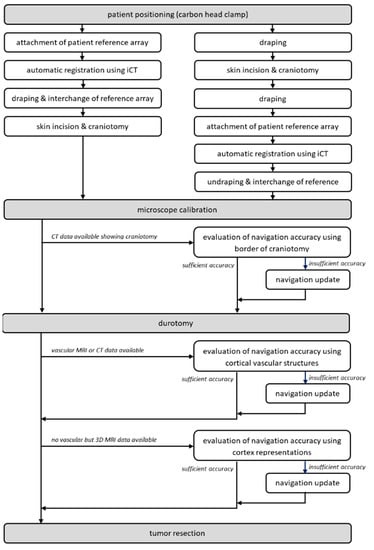
This study aims to report on the capability of microscope-based augmented reality (AR) to evaluate registration and navigation accuracy with extracranial and intracranial landmarks and to elaborate on its opportunities and obstacles in compensation for navigation inaccuracies. In a consecutive single surgeon series of 293 patients, automatic intraoperative computed tomography-based registration was performed delivering a high initial registration accuracy with a mean target registration error of 0.84 ± 0.36 mm. Navigation accuracy is evaluated by overlaying a maximum intensity projection or pre-segmented object outlines within the recent focal plane onto the in situ patient anatomy and compensated for by translational and/or rotational in-plane transformations. Using bony landmarks (85 cases), there was two cases where a mismatch was seen. Cortical vascular structures (242 cases) showed a mismatch in 43 cases and cortex representations (40 cases) revealed two inaccurate cases. In all cases, with detected misalignment, a successful spatial compensation was performed (mean correction: bone (6.27 ± 7.31 mm), vascular (3.00 ± 1.93 mm, 0.38° ± 1.06°), and cortex (5.31 ± 1.57 mm, 1.75° ± 2.47°)) increasing navigation accuracy. AR support allows for intermediate and straightforward monitoring of accuracy, enables compensation of spatial misalignments, and thereby provides additional safety by increasing overall accuracy.
This content was originally published here.
