Will A.I. Replace Writers?

In January, media outlets sounded the alarm on A.I.s that will end writing as we know it. The media coverage sparked a lot of conversations among artists and writers who loudly proclaimed their hatred for A.I. technology. On Facebook I saw comments like: “The words ‘digital’ and ‘art’ go together as well as ‘food and sh*t‘” and those were some of the nicer ones. “Nonetheless, whether anyone likes it or not, A.I.s like Jasper, ChatGPT, and SudoWrite have been assisting people with their writing projects for years. They’ve only reached a new level of evolution which has caught the attention of the media. Yes, I understand that automation will eventually take over the world but most experts agree, if you work in the creative field, you’re safe. In fact, it’s believed that A.I. technology will increase opportunities for artists, but only if we get in the game. Today, A.I. technology can offer translation, audio, and co-authoring services but not many writers are ready which could be disastrous because according to Google’s CEO Sundar Pichai, “artificial intelligence (AI) will eventually have a bigger impact than fire, electricity, and the internet.”
I’ve watched several content creators ask ChatGPT, (the A.I. at the center of this controversy) a few questions so I’m gonna do the same but I’m not at all interested in its answers, I’m interested in its technique. Let’s see if A.I. is really a threat to the writing profession or if this is all just fearmongering.
Can An A.I. Write Like a Human?
As I experimented with ChatGPT, I first asked it: Is A.I. technology a threat to authors? Here’s what it had to say:

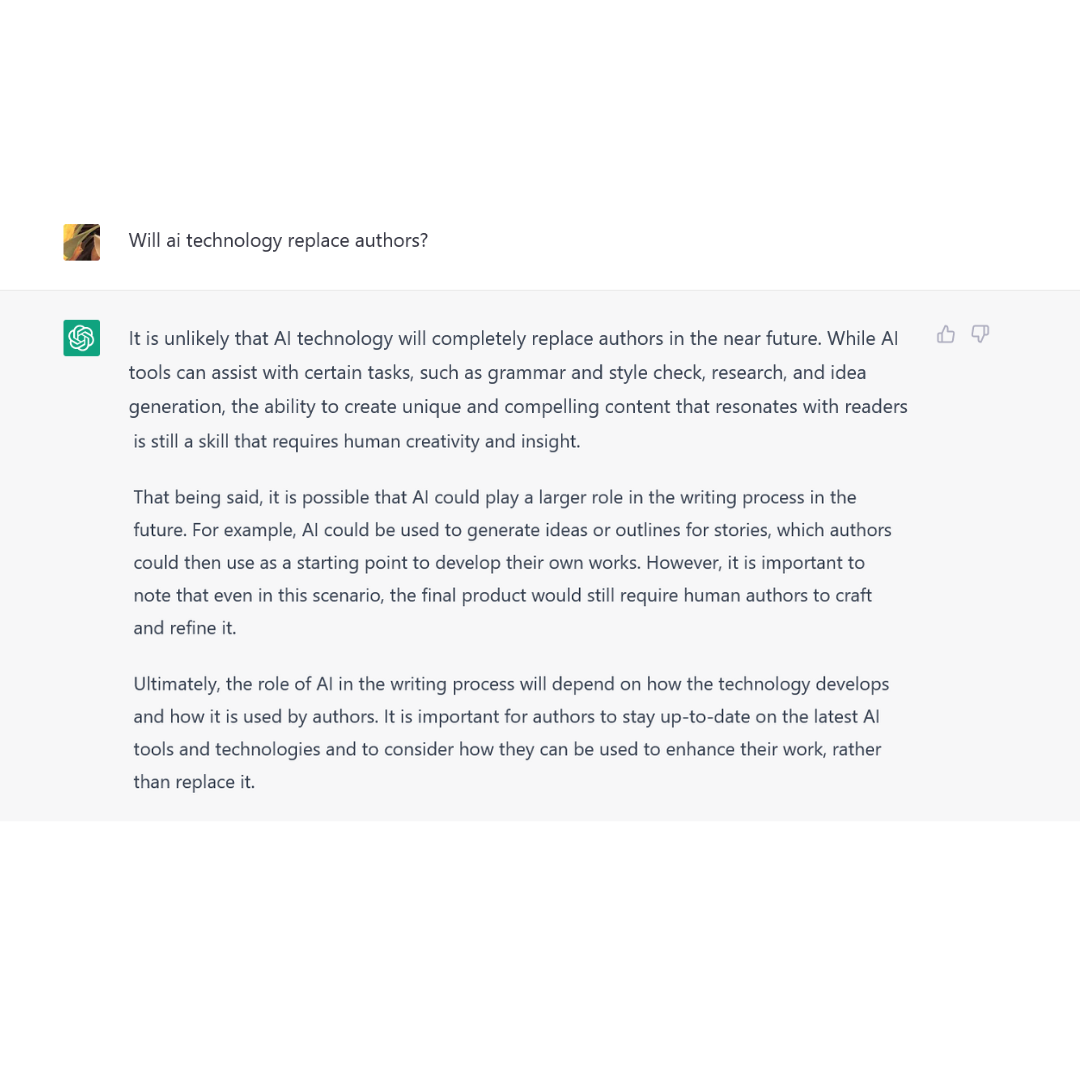
To test its ability further, I repeated the question but in a different way: Will A.I. replace authors? Here was that response:

As you can see, it regurgitated a lot of the same lines without much variation in the answer. Also, notice how ChatGPT avoided contractions like “it’s” and used “it is” instead. But this isn’t the only issue with ChatGPT because the A.I. has been found to spit out incorrect or biased information and that’s where its real weakness lie. If you depend on this technology for research or data analysis, you may find yourself disappointed, because it can be wrong. You still need to fact-check and edit the project to ensure the quality of the work because it’s not always up to professional standards.
Nonetheless, as you can see, ChatGPT could pass as human but I’m not completely blown away, so I believe our jobs are safe—for now. I tried to use ChatGPT to write this article but I found its work substandard and ended up trashing 95% of it. (I only kept some of the headlines.) I think it’s great for an outline and perhaps inspiration but not much else. However, your needs may be different so I encourage you to try it out while it’s still free.
AI and Copyright: Who Really Owns The Content?
Currently, in the U.S. only humans can claim copyright to a work but that could change as this technology evolves. However, in China, an A.I. was granted copyright protection for meeting the requirements for original work. These are two different countries, with two very different takes on who or what deserves copyright protection. As if that weren’t enough, the E.U. has a similar stance to China’s but it’s more complicated because content generated by A.I. can be ruled a work but it needs to be decided by a court if it’s original in order to be granted copyright protection. In other words, if you’re a writer using A.I. to assist you, there may be challenges to the ownership of your work. For example, if you’re a freelancer, and write an article and then, sell the first rights, that company or individual who bought it could claim more rights because the work was A.I. generated and therefore not protected by law.
Another thing artists need to consider is that fact that there may be companies or clients who might not want A.I. generated work. Most businesses want full legal control of the work they buy. Granted, this is something that has yet to play out in the courts but it will. Right now, ownership isn’t clear at least not on an international level.
Isn’t A.I. Just Plagiarism?
Charlene Putney, co-creator of LAIKA (An AI creativity tool) was asked that question on The Creative Penn podcast and her answer was, “Every time you use LAIKA you put in a prompt, so for example let’s say, we put in a prompt: ‘Deep down I always knew.’ Every single time you use that prompt with any brain, you’re going to get a different result. Actually three different results, we give three different inferences each time. There isn’t really going to be a situation where you and me come up with the same thing. So there really isn’t a way in which we can be plagiarizing each other or anybody else.” She also mentioned that if someone were to use copyrighted material on their site, they would take it down which is good to know.
However, not everyone is following this example because several artists have already found their work being used to train AIs like Stable Diffusion and Midjourney. Both companies are currently being sued for copyright violations with lawyers calling the A.I.s “parasitic” and declaring, “it would put artists out of a job.” And although I don’t agree with that, I do agree that artists need to be compensated for unwillingly participating in this A.I. experiment. You see, most A.I.s are trained on online content such as blogs, art websites, and social media posts which puts them at high risk of copyright and trademark violations. It looks like they knew the risks and went ahead anyway because there’s so much money to be made if A.I. goes mainstream.
The Glaring Privacy Issues
The ChatGPT website warns users not to reveal any personal or business information to its A.I. because it does share data with 3rd parties. Also, keep in mind that it’s still in Beta which means it’s still in training and that means anything you put into it, can be used to train the A.I. Recently, Amazon warned its employees about using ChatGPT after the A.I. was found mimicking internal data. So if you’re using an A.I. like this for a client, make sure they are aware of ChatGPT’s privacy policy.
This alone may be a deal breaker for some but it’s been argued that this data collection is necessary because ChatGPT has been trained on internet content as well as things in the public domain and most of that content was made by old, Caucasian males. So for this technology to evolve, it needs to be trained on all kinds of content meaning, content created by people from diverse backgrounds. It’s important that all artists and writers are represented in this next wave of technological advancements but only if they are fairly compensated.
The Possible Dark Side Of A.I.
It was brought up during The Creative Penn podcast that A.I. could be used by publishing companies to cut out the middle man and produce books without any need for writers. These days most publishing contracts take the majority of the licensing rights of an author’s work and that could be disastrous. Publishers could create more books in the author’s voice (style), without permission simply by feeding the A.I. an author’s backlist. This is why it’s so important to watch what’s going on in the industry because if we’re not careful we could be completely cut out of future deals. It happened in the U.S. during the digital (ebook) revolution when publishing companies tried to claim copyright on technology not yet invented. This is called retroactive rights grabbing by the way and I talked about it in my post: Licensing Rights & What Authors Should Know if you’re interested in learning about how bad things can get in publishing.
AI and the Future of Writing: The Possibilities
I know, that this post wasn’t very flattering but I’m not pessimistic about A.I., I know this technology is going to evolve and we will need to evolve alongside it. A.I. will bring new artists to the forefront and new forms of art. In fact, A.I. is already ushering in a new era of virtual reality, gaming, and movies which will all require content from writers and artists. So this is the dawn of a new era, just like artists had to learn how to create in digital form, we’ll need to learn how to create using A.I. and that’s going to be exciting for the majority of us. Sure, the A.I.s of today aren’t very impressive but they will be in a few years and that’s when the paradigm will shift. The only question now is: will you be ready?
Anyway, if you found this post helpful, please like, comment or share.
This content was originally published here.

